

Stephen Colbert is, unknowingly, my role model
As The Late Show enters its final week, I ponder how I have followed the career of the comedian through the years—and how I unknowingly looked up to him all this time.

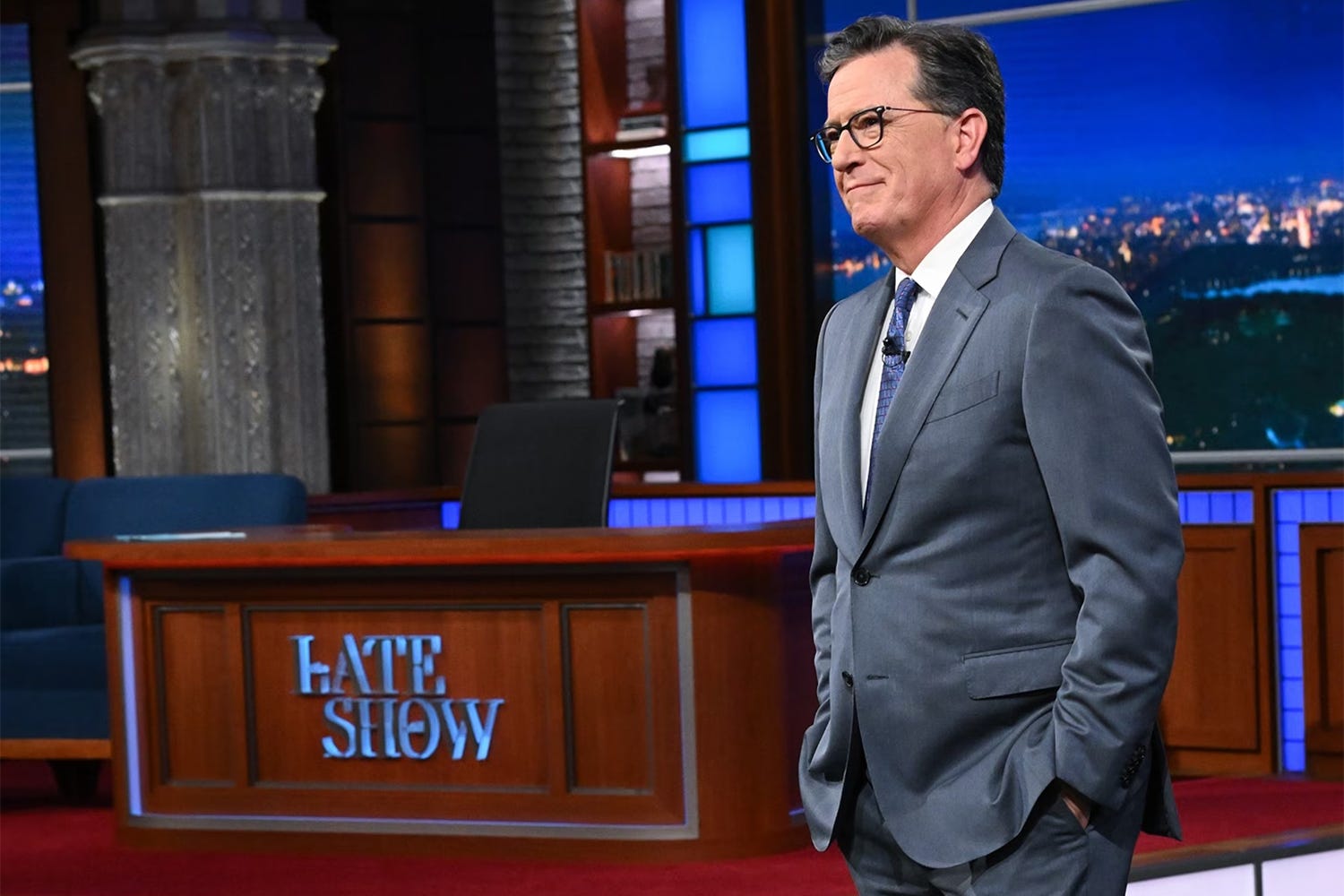
For months I have made a note that, this week, I should be releasing a piece about Stephen Colbert, coinciding with his final week of The Late Show.
I mean, I should. I’d consider myself a fan of the guy, even if, due to lack of access and time, I haven’t seen everything he’s in. My appreciation of him is centered mostly on his late night work, from The Daily Show during the height of the Jon Stewart era, to his decade-long performance as “Stephen Colbert” on The Colbert Report, to inheriting the equally storied mantle of David Letterman and The Late Show (or, as it was then, Late Show, without the article).
Sure, I’ve also watched some of his other things—some clips of his work on The Dana Carvey Show, which launched his (and Steve Carell’s) career; the episodes of The Ambiguously Gay Duo that appeared on Saturday Night Live; that one episode of Whose Line Is It Anyway that he appeared in—but I would never say I have seen everything, which in these times automatically disqualifies me from writing some sort of retrospective (up to this point) about the comedian. (I mean, I should only be able to say that if I have seen Strangers with Candy.) As if he has watched every movie he has had to help plug on his late night show, as he himself would attest.
And also, despite giving myself months to think about it, I’m not entirely sure how to write this piece. Again, I’m not qualified to write a retrospective. And I’m not sure I can use this to pass comment on the state of affairs these days. The circumstances behind Colbert’s cancellation—circumstances which he has accepted with such grace, which can’t be said for the most of us—remain pretty damning: CBS cancelled the show supposedly for “financial reasons” while their new corporate owners were trying to get a merger through under the watchful eye of Donald Trump. Between that and the president’s glee of getting late night hosts he deems to have personally offended him yanked, there has to be something there about how intolerant we all—not just one side, but we all—have become of portrayals that don’t align with our personal values and biases? But everyone else has written about that.
Is there really anything else I can add? There’s really nothing else I can add. I can’t even use the fact that I have bought both of his books as “Stephen Colbert”—I remember seeing I Am American And So Can You!, and months later its sequel, American Again: Re-becoming the Greatness We Never Weren’t, both times buying them, on hardbound, without my usual bout of analysis paralysis—to proclaim some special perspective. All I am is a guy, like many others, who has followed some of his career, and liked what he saw, like it enough to keep on returning. Mostly.
I was always a bit of a news junkie, in part because I was always fascinated by how the news is presented in other countries. It was a rabbit hole. Catching a local channel air Dan Rather (and also David Letterman) every night led to catching a Japanese cable channel airing clips of Peter Jennings—that is a different essay altogether—and then to me, years later, discovering The Daily Show, which happened to air on another local cable channel.
I didn’t watch religiously. The schedules kept changing, and besides, it was on relatively late at night, and I had homework to do, and I was always more of a morning person than a night one. But I had caught enough to understand how good Jon was at skewering the Bush administration and its military interventions in the Middle East, and along the way, the work of his “correspondents”, including one Stephen Colbert, who somehow toed the line between authority and absurdity, with an almost malicious glee in his eyes and his voice, sometimes at the same time.
(It’s really a shame the old TDS video archive is no longer online, so there are really a few clips of that era to come around. That also means discovering clips I haven’t seen before—this one not included; I have watched this many times.)
And then Stephen went on to launch The Colbert Report. I was going to call it a showcase of his abilities but that undermines the fact that, throughout his stint on TDS, he built “Stephen Colbert”, the “well-informed, poorly-informed, high-status idiot” persona that lent itself wonderfully to a parody of those early 2000s political punditry programs like The O’Reilly Factor. He skewered those shows by speaking its language—mostly the self-importance, something he mined successfully for so long and in so many ways—and did so for a whole decade without giving away the façade. I mean, he did say early on it’s a character, but it’s one he brought beyond the show, most memorably at the White House Correspondents’ Dinner in 2006.
Perhaps more deftly, it was a character where he put just enough about him to make it as realistic as possible, but also as heightened as possible, so much so that when he made the transition to network television—explicitly stating that he is retiring the character and doing The Late Show as himself—people still saw him, and judged him, as the character he portrayed more than a decade ago.
Of course I couldn’t watch The Late Show on television, because, again, I live in a different country. But YouTube being firmly entrenched in the arsenal of American late night means I was better able to see how his show evolved this time around. More of struggled, especially in the beginning, when in an attempt to differentiate himself from his previous work, Stephen leaned heavily on the absurd (but not exactly stepping on the toes of late night’s original absurdists, David Letterman and Conan O’Brien) and not being as responsive to the news of the day. While we would remember him more now for his blistering monologues and segments on the Trump administrations (and the Biden era in between, which, whether you like it or not, is really defined by his predecessor and eventual successor) we also got to see Stephen Colbert, the thoughtful interviewer, raised on Tolkien and Dungeons & Dragons as he dealt with the death of his father and brothers, with a rich mine of stories to tell from his childhood to his comedy beginnings.
It’s this Stephen that I really appreciated. Sincere, but not cloyingly so. A man of convictions, not just politically but spiritually—and I say this as a man who isn’t very religious, but had such an upbringing. I remember his interview with Joe Biden very early in his LSSC run, which touched sensitively on the many deaths the latter has seen in his family. There is also, later in his career, Stephen’s conversation with Anderson Cooper, where both talked so profoundly about grief and love—something that has stuck to me to this day, after, you know, all that.
But eventually, the rise of Donald Trump—and, yes, Chris Licht joining as executive producer, bringing with him his experience in news production—would focus the show’s energies, and turn it into the comedic and political force that it has been for the last decade or so. At a time when many people lament the “death” of late night television, particularly in the time of viral videos on the general fragmentation of the cultural zeitgeist, Stephen made the format exciting. Sure, it’s not all him—he did bring, after all, the legacy of the Jon Stewart school of political satire, coupled with a dash of the weirdness of a few stray branches of the Saturday Night Live tradition, and wrapped it around his own personality and sensibilities—but his presence somehow gave that most eminent of American entertainment formats a timely purpose again.
Unfortunately, mainstream late night’s attempts to, in one way or another, repudiate the worst of the United States’ white imperialist tendencies flies in the face of what has become an essential demand not just in American society—as if I could speak with authority about that—but all of humanity in general: to see everyone follow our exact belief system, and to toss those we have deemed even slightly deviant from it. Maybe a part of it is because not everyone is aware that Stephen was playing a character on The Colbert Report—how many people lament that he was funnier back then because he skewered the left, even if he really did so to ultimately skewer the right?—but we all know, somehow, how now society demands that we choose a side and defend it to the hilt? That no matter how often some call for people to lower the temperature, we will now always revert to schadenfreude as a default mode, the suffering of others as the only way for us to be happy, as if it’s a zero-sum thing? And somewhat ironically, the character’s traits—and especially the whole concept of “truthiness”—has become our default worldview, our lingua franca.
Stephen tried so hard to rise above all that, but his dedicated audience demanded otherwise. Considering how late night television has always acted as a utility—how it helped Americans, and eventually the world, process the day, going back to the days of Johnny Carson—it was inevitable the format, and the hosts, would reflect what its audience wanted. We enjoy watching hosts like John Oliver and Trevor Noah eviscerate their targets. It’s the reason why Jimmy Kimmel, equally beleaguered under Trump, seems poised to inherit Stephen’s audience at the end of this week. It’s the reason why Jimmy Fallon, whose version of The Tonight Show is built more as a made-for-the-Internet variety show with little in the way for political comment, is often belittled despite having carrying the franchise for over a decade now.
As someone who lives outside the United States and has had enough of how Trump sucks the oxygen out of the room, especially for people like me who have their own authoritarians to deal with, it was too much. I eventually stopped watching all but Last Week Tonight after the 2024 elections. (Being a weekly show just wasn’t as stressful to me.) Again, I will be the first to admit that I am really not qualified to write this piece. But then, here I am, and here we all are.
I have been thinking over the last few months whether there are people who I considered heroes, or at least role models. I’m not sure, because I haven’t been so hyperfixated on everything a person does. But if there’s anything that came to focus in the months since The Late Show’s cancellation was announced, it’s that I have admired Stephen’s intelligence and wit and confidence, something that I have seen not just on his current show, but throughout his career, or at least the parts of it I have seen. I admire his grace. I admire his loyalty to his wife Evie. I admire how he can be the guy with a slightly askew sense of humor—how, for one, he builds on the obscurity of his references to drill down a universal point—but also be the intelligent guy who nevertheless doesn’t wear his smarts on his sleeve. I admire his reverence for history, judging from David Letterman’s appearance on the show last week. Sometimes I wish I was like him—I mean, I know I can never be like him, but in my low days sometimes I wish I was accepted the way he was. I’m not a more terrible person, right?
And also, one more thing—thank you, Stephen, for that rap on Whose Line Is It Anyway? even if you didn’t really like it, and for bringing levity to the thankless days at my first job when I could sneak my way towards the bosses’ Slingbox to watch you and Jon, and for being one-third of Who Made Huckabee?, and for bringing us ultimate Colbert Bump beneficiary Jon Batiste, and Laura Benanti as Melania Trump, and also, my favorite ice cream flavor ever, which is not going away, thank the monkey’s paw.
But why am I writing like Stephen is dying? His show just got cancelled. He’s writing the next Tolkien film. He might as well show up on Jimmy Kimmel Live as a guest host in a few weeks’ time. I may no longer be able to realize a recurring daydream of watching The Late Show at the historic Ed Sullivan Theater—to be fair, my kind aren’t welcome in the United States anyway, so, yeah, daydream—but he’s not going away. This may all feel like a victory for those who want opposing voices to shut up—which is all of us, only this guy is on “our side” so we’re losing—but he’s not going away. “You can take a man’s show away, but you can’t take his voice,” David Letterman said last week. Very true.